Book Appointment Now
Apartment communities on Estonia’s islands prepare for renovation
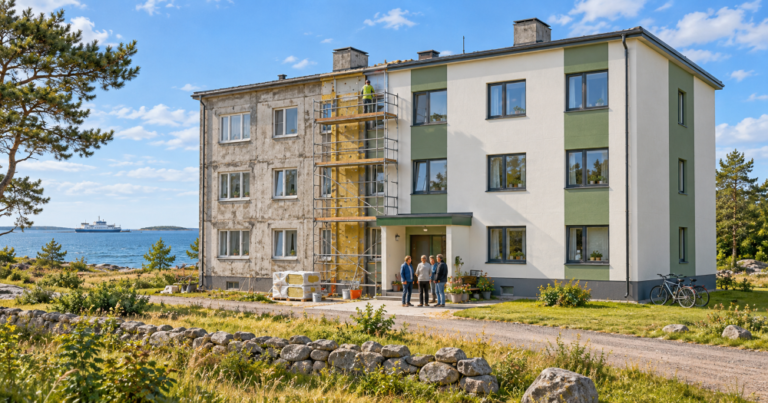
When it comes to renovating apartment buildings on Estonia’s western islands, the conversation quickly turns to insulation, heating systems, ventilation and energy efficiency. In reality, renovation starts much earlier – with residents reaching a shared understanding of what their building needs, which solutions they can afford and how to approach a major investment together.
As part of the Citizen-Led Renovation (CLR) programme, the Estonian Islands Energy Agency (EISEA) is supporting three apartment communities on Estonia’s Baltic Sea islands throughout this process: renovation projects are being prepared for 13 apartment buildings in Suuremõisa on Hiiumaa and in Aste and Liivamäe on Saaremaa, involving a total of 182 apartment owners.
Renovating apartment buildings on Estonia’s islands comes with particular challenges. A smaller construction market, limited competition and island logistics can affect both the organisation and cost of the work. Buildings also vary in condition, while residents have different financial capacities to contribute to major investments. This means that renovation models that work in mainland Estonia or larger cities cannot always be directly transferred to smaller island communities.
EISEA supports housing associations in gathering the information they need to make informed decisions: the technical condition and energy consumption of their buildings, the solutions available, their costs and the potential impact on future housing expenses.
Listening to residents comes first
Work with the three pilot communities began in 2025, starting with an assessment of the buildings and residents’ expectations. In February 2026, surveys explored how residents viewed their current living conditions, what they expected from renovation and what concerns they had about the process.
In spring, workshops were held in Aste, Suuremõisa and Liivamäe, bringing together a total of 90 participants. Residents discussed possible renovation solutions, costs and the decisions their housing associations will need to make as the projects move forward.
Each community has also selected local CLR ambassadors, who act as a link between residents and the energy agency and help gather feedback from the community.
This approach follows the principles of citizen-led renovation (CLR): renovation is seen not simply as a construction project, but as a process in which residents are actively involved in decisions about their homes.
Renovation also has to be affordable
All three pilot communities are currently in the preparation phase. Technical and energy consumption data are being collected, and the next steps towards energy audits are being prepared. This will allow different renovation scenarios, their costs and financing options to be compared.
Affordability is one of the key considerations. A more energy-efficient building can mean lower energy consumption and a better living environment, but the investment has to be made first. In an apartment building, people with very different incomes and financial circumstances need to reach a common decision. Before committing to an investment, residents therefore need a clear picture of how renovation will affect their monthly housing costs.
Lessons from Estonia’s islands can be useful elsewhere in Europe
The experience of Suuremõisa, Aste and Liivamäe could also prove valuable for other housing associations on Estonia’s islands and elsewhere in Europe. Small island communities often face similar questions: where to begin, how to access the necessary technical expertise, how to assess affordability and how to build agreement among residents.
The Estonian pilots therefore aim not only to prepare these particular buildings for renovation, but also to gather knowledge and practical experience that can be applied in other island regions.
EISEA’s experience so far shows that successful renovation depends on more than technical solutions. Resident involvement, reliable information and a clear understanding of the financial impact are equally important. Once this groundwork is in place, communities can move on to detailed planning, financing and, ultimately, construction.